Showing posts with label travel. Show all posts

Sunday, 26 February 2017

14. Starting a PhD: a non-linear approach

Cathedral of St. Andrews, Scotland (2013)
For the last few months I have taken a hiatus from writing my blog to focus on applying for a PhD at the University of St. Andrews. What a harrowing adventure! From start to finish, it was a good 3-month process with dozens of re-writes, stress and the agonizing wait to hear back. Even starting early, and following advice from friends and online, there were so many unknowns going into it. There were many moments of self-doubt, which had the uncanny ability to creep in when I needed it the least. With the support of some amazing teachers, mentors and friends, I managed to get someone interested in the incredibly nerdy stuff I love – Roman Aegyptiaca. In a post coming soon I will write about what that is, but for now…I will be studying Egyptian-looking things in Roman cities.

Khoiak Procession from the Nile Mosaic of Palestrina, Italy (2014)
While the outcome might seem straightforward, (person X likes (topic), studies Y = goes on to PhD) the path is rarely as clear as this. An interesting part of the curation on social media, is all of the crap that you don't want people to see can easily be ignored, not reported or underplayed. I focus and emphasize the things that I am most proud of, that arguably demonstrate a clear connection to my goals and objectives. It's not always a conscious choice, but it excites me to share upcoming adventures (research trips, excavation work, conferences etc), and even if those activities are the exception to fairly humdrum periods of time, I try focus on the positive and engaging elements in my life. That curation presents a deceptively well-planned and linear pathway however.
Roman road excavation. Merida, Spain (2014)
Like many people in the 'millennial' category, I have taken a strange circuitous route to finding a path. For many years I was uncertain what it was I wanted to do, or how I would even get there. My professional or academic shortcomings would emerge when I contemplated pursuing any concrete direction. Supporting myself through school involved things that looked remarkably unrelated: Italian train information CSR, custom picture framer, freelance artist, call centre CSR, book and video store sales person, maternity store sales clerk, telecommunications CSR, office administrator for an engineering firm, work-study intern with a museum, housing assistant, university credit secretary, repairs assistant, catering delivery driver, and endless amounts of 'exposure' work (free) and side-hustle to get through.
'Work for exposure? Oh can I?' Roman wind chime. Merida, Spain (2014)
Despite working in areas that for many would happily suffice as a career, I have always been half in and half out. Every work placement is an opportunity to learn useful skills, but nothing had any real resonance to me or inducement to stay long term. I always had an eye to what might be ahead and to apply to any and every opportunity, often ending comfortable employment for a scrambling uncertainty.
Egyptian relief. Louvre, Paris (2016)

Sure, I love ancient history, archaeology and art...but what can I really do with all this?
Throughout all of that, I knew I wanted to spend my life studying and sharing aspects of ancient history through art and writing, but unsure as to what my mixed-bag of skills would allow me to do. When I drew all of my work experience, hobbies and passions together a picture emerged that put the question to rest: I want to be an educator of Ancient History. Fundamental to this was attaining a PhD, and getting more focused and industry specific work experience.
See? So much time spent on ancient walls. Hadrian's Wall, England (2013)

Having been accepted to St. Andrews, I now have several months to plan and prepare – skills my varied work experience has hammered into me. Much of the existential angst of ‘what will I do and where will I be next?’ can finally be put to rest for the next few years. With the patchwork of experience that has sustained me, now behind, I look forward with more clarity and focus.


Sunday, 9 October 2016

13. Behind the Scenes: Learning to Supervise in Aeclanum

Learning to train archaeologists

After the two-month excavation in Policastro Bussentino last year, I was keen to improve on the skills I had learned. I had discovered during that excavation that I was actually really interested in taking more of a leadership role, but was not yet sure how much I knew, or yet needed to learn, to do so. A fortunate meeting with my former teacher, Dr. Ben Russell from the University of Edinburgh, alerted me to a dig that would be happening in Aeclanum (modern Mirabella Eclano) for September 2016. The excavation is an ongoing joint-venture with the University of Edinburgh and the Apolline Project (http://www.apollineproject.org/) with co-director, Ferdinando De Simone.

With this in mind, I had been anticipating an exciting few weeks with two of my brilliant friends, both currently undertaking PhDs at the University of Saint Andrews and Edinburgh University. Packing for the trip (both passports in tow!) is one of the best parts...slowly I am getting more and more efficient.
With a few days spent adventuring and relaxing in Rome beforehand, we were all ready to get our hands dirty.
Ms Moodie, Ms King, and Me (from left) surprisingly clean !

One of the most interesting parts of getting involved in a dig like this is that while the directors and supervisors were well-seasoned, the site itself was essentially starting in many areas with virgin soil. Previous excavations had been carried out several decades before (in a few areas), and more recently a commissioned archaeological dig had been done by a commercial unit.
But a variety of reasons, the work being done in this season could be viewed as the ground work for the future of the site. That is an exciting prospect for anyone to be a part of, but I was especially keen since my understanding of how to supervise a trench was somewhat problematic. I was fairly sure there was a lot that I did not yet understand, but was keen to get in and learn.
Saggio Cinque hard at work!
Coming to train on this dig, I was pretty keen to support younger students and help them feel confident. One or two items tend to come up whilst excavating in field schools which I tried to be mindful of. Traveling alone for the first time and living in a large group can push peoples comfort boundaries (shocking, I know). So with experience traveling quite a lot in Italy, and the last six months of working for Italiarail (the American vendor for the train network in Italy, Trenitalia), we were able to give advice and help sort out peoples' logistical issues fairly easily! All these things in mind, it was a grand opportunity and beautiful location.
The Site
Aeclanum is situated in modern Mirabella Eclano,  Irpinia region of Campania (inland). Connected by the legendary Roman road-building, Aeclanum was situated in a central point along the Via Appia. During the Social Wars (around 89 BCE), Aeclanum had been sacked by Sulla's forces. It was rebuilt, and seemingly flourished in the 2nd CE when it became the Colonia Aelia Augusta Aeclanum. There is evidence of many phases of rebuilding, additions and repairs/re-purposing until Aeclanum sort of disappears from history after 662 from the campaigns against the Lombards of Benevento. 
The site itself was set within some idyllic green hills and edible vegetation was scattered throughout. Quite a few buildings were excavated and reconstructed already on the site, which drew tourists to this lovely town. Some building identifications are being reviewed, as new methodologies and interpretations were being applied to this site.
There were number of specialists on-site to do digital mapping, ceramic analysis, and even drone photography (which took brilliant photos)! There were many types of dwellings, buildings and some roads visible. The scope of the site is not yet fully known, but there were many intriguing possibilities. 

The paving stones and hypnotic brick patterns were lovely to see every day. I've always been impressed by the effort and artistry of the brick work, especially as recently was pointed out to me, they would have been covered.
Of course! The work is so beautiful on its' own that it seems a completed decoration. Though I cannot do the architecture justice through simple quick pen sketches in my Moleskin, I do keep trying!
 
This one is, as usual, a bit squint, but it is a lot of fun to have little drawings of my travels to mark the memories.
The Team
Our group was a mix of University students from all levels and people who came on this dig to get experience for a career shift as they sought to start a new direction in their lives, which is always commendable!
Saggio Cinque (Trench 5). Photo by Crystal Rakes
The energy and effort of the students I got to work with was excellent. Rain or shine, our team of Saggio Cinque was a hard-working group, and hilarious. My senior supervisor (who I tried to learn as much as possible from) brought very approachable and engaging teaching methods to the site which was a huge help.
All in all, these were not box-ticking learning objectives, rather an attempt at trying to give a taste of the concrete outcomes they needed to start a career in archaeology. I may have only a few weeks as a junior supervision, but it was incredibly informative right away being on the other side of a field school.
I can't go in to much detail, or perhaps shouldn't, as it is an evolving and ongoing project and season, so what I can say about what we encountered in Saggio Cinque (now famously under the hashtag #SaggioCinque) was the following.
The Presence of Absences
My previous dig experience in Greece included evidence of ancient and modern grave robbing. Working on a salvage dig was fast-paced and quite hush-hush about what we found, since the graves were near the surface and not hard to spot. Whereas, what was surprising in Aeclanum, was seeing the evidence of someone trying to remove the massive limestone slabs (unsuccessfully) and apparently giving up. Poaching finished building materials and re-purposing them for newer buildings was pretty standard practice in antiquity,  but it was interesting to see evidence of a failed attempt.

Politics and Archaeology
Whilst our archaeological field school lodged in Mirabella Eclano, there was a bit of a press furor going on around us. Some of you might have seen this picture:

(Archaeologists in the Nursery, Moms in Revolt) newspaper headline, a local misunderstanding about our accommodations. This strange bit of press, while seeming contentious, actually gave the opportunity for some interviews on site and publicized some of the exciting things we were doing.

To hear an interview with our site directors, you can check out this Sound Cloud link:
https://soundcloud.com/airadioariano/aeclanum-sta-per-concludersi-la-prima-fase-della-campagna-di-scavo

Mirabella Eclano
The people of Mirabella Eclano were always very kind and gracious. I had a lot of great conversations using a mixture of French/English/Italian with quite a few locals.
There were some real gems of cafes and restaurants; my favourite cafe, Zucchero e Vaniglia, served some incredible pastries and perfect portable coffees- superior additions for a dig break.

Our main port of call, however, was the cafe/bar at Hotel Aeclanum. Many drinks, chats and post-dig hangouts took place at this tried test and true hotel bar.
The town of Mirabella Eclano was full of affordable little restaurants and bars, beer festivals, and very pretty views .
If you are curious and would like to find out more or maybe get involved, please check out the Apolline Project Website: http://www.apollineproject.org

Ciao for now!

Tuesday, 9 August 2016

12. Baiae: the original Sin City

Ancient Baiae
Whilst I was excavating in Policastro Bussentino, I decided to use my down-time productively and get to know the cities in southern Italy. The train routes were cheap and plentiful along the Tyrrhenian coastline, with beautiful views on this regional train ride from Napoli Centrale.
One such a day trip, I ventured from Naples on an ambitious outing to see some ancient cities of Magna Graecia. I say ambitious because by foot it is a very long walk from Baiae to Cumae along a winding hillside with no shoulder or footpath- all in all, a 15 mile walking day.
When I arrived at the ancient town of Baiae in Gulf of Puzzuoli, I had the unique experience of being in a spectacular archaeological site entirely alone

It was a beautiful clear morning and I rocked up without having purchased a ticket (tickets you are supposed to buy at Cumae first then head over to Baiae, unbeknownst to me). Luckily, the park steward let me in for free and after I explained my disorientation!
The archaeological park was stunning, as you can see. The multi-story bath complex was built into the hillside, and standing atop the complex it is not hard to imagine why the super-rich of the Republican period into the Principate were drawn to this place. This area was rich in volcanic activity (Vesuvius is very close, of course) which the Roman architects and engineers were able to channel into sulphur springs - perfect for hot baths!

There seemed to be endless rooms, and many with mosaic floors still remaining in situ. The mosaics are, appropriately, water-themed with divinities and typical meander and wave patterns. Water and neglect have left them in the current state of disrepair they are in, but you can see evidence of the gorgeous technical ability.
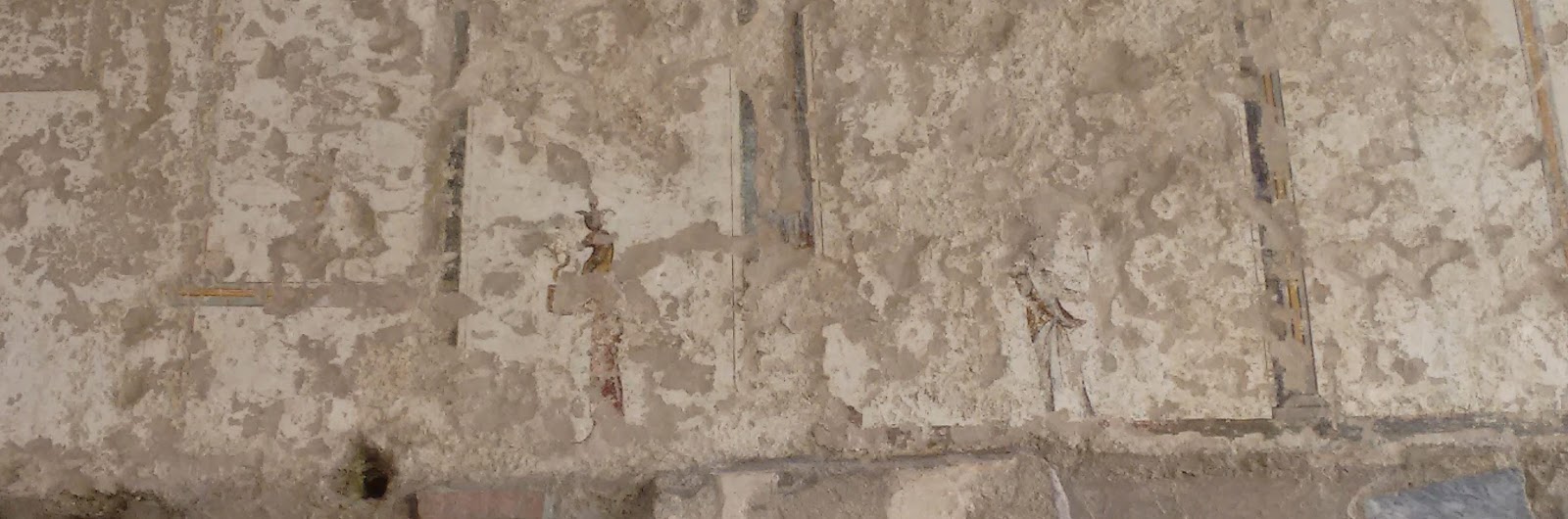
A surprising amount of painted plaster was still visible as well, with typical decorative motifs and some strange ones. The frescoes date to two particular stylistic phases: the middle of the 1st century A.D., called the 3rd Pompeian style (notably because of the 'Egyptianising' features they possess. That stuff is my research jam, and I shall in due course dedicate many 1's and 0's of the internets to discuss it.
 Below I've tried to highlight the figures which have zoomorphic features and elements meant to evoke Egypt (costumes and symbols).

A later, 2nd century A.D. phase is also present, which could be viewed as slightly irregular and a bit shabbier in execution. This little green dragon below was part of that later design.

Temples, Pools or ...? 
There were a few cisterns still, and one was even fully intact. The echo inside made singing sound like I was using a microphone. Yes, I sang a few Disney songs before giving my spot to the tourists who were waiting at this point, bemused, outside. Nothing like being in a archaeological sites for belting out tunes (Florence and the Machine). Amusingly, it wasn't until a month later I learned the name of it was called the "Temple of the Echo". While not a temple, the name was still pretty on point.
Top-view of the cistern"Temple of the Echo"
Inside the "Temple of the Echo"

The 'Temple of Diana' that lay just outside of the archaeological park is a husk of its former self, but still pretty damn impressive.  This was built during the reign of Hadrian, one of the greatest building emperors of the Roman Empire. The influx of funds in the 2nd century A.D. - which manifested earlier in the frescoes being added to - coincides with the building of this structure. Called a temple erroneously, it has been argued to be a pool, a further spectacular addition to the bathing complex.
As I neared the bottom of the hillside, I could see a MASSIVE temple-looking structure, across the (modern) street, outside of the bath complex. I stood to sketch it for a while, and saw that it was a 'Temple of Venus', which, given the history of this elite spa-town, would have made perfect sense.
Prolific in his building, this massive Hadrianic era building could have been a casino, pool, or possibly religious building- all suggestions I read at the site. The lingering naming of the building, 'Temple of Venus' betrays the varying perceptions of it that carried on over the last thousand years since it was in use.
 The political landscape in Rome during the late Republic into the Principate involved the elevation of the Julio-Claudians and funding to their parton deity- Venus.
 Julius Caesar had a villa in the area, and other notables like Pompey Magnus, Caligula and Septimus Severus all frequented the area.

Temple of Venus at Baiae

Augustus (nephew to Julius, nee Octavian) took over the entire complex (and much of the town), adding it to his sizeable imperial property. Controlling where the rich went to relax, socialise and play was pretty much Augustus' raison d'etre during his early formation of how the empire would be run. 
Anyone watching the Versailles (2015) series right now could imagine the same processes occurring in Rome under Octavian as was happening in the court of Louis XIV. Like the French nobles who were forced to adopt new practices and behaviours, Rome's elite probably required some wrangling to stay in the lines as Augustus delineated them.  Controlling spaces goes a long way towards controlling behaviours and shaping ideas.
Squinty little study of shapes at the Temple of Venus
The analogy of Versailles can be taken farther, as Baiae developed a reputation  for moral bankruptcy, with salacious and scandalous behaviour taking place in the steamy rooms of this wellness retreat. One commentator on the depravity of Baiae's baths and wellness centre was Seneca the Younger, describing it as a "vortex of luxury" and amusingly, "harbor of vice". I suspect he may not have been on the guest list for the sexier parties.

With Romans, physical wellness was linked with spiritual wellness. The presence of temples in a site like this would make a lot of sense. 
A significant part of the blue-bloodedness of Julius Caesar, and thus his descendants, was his claim of being related to the divine being Venus (through Aeneas, of Trojan war and founding Rome fame). He is a big deal in mythology, and would have been in the eyes of the Roman people. To claim mythical descent through him to Venus, the Julians linked themselves to the divine.
It would be very appropriate then to have a bloody great big temple in this playground of the wealthy with their patron deity stamped allover it. When sacrifices and homages were being paid to that divinity, the connection to the Imperial family couldn't have been far from the person's mind.

Not surprising then, that as time and memory faded the original meaning of these buildings more mundane structures, nestled along the coast, took on impressive religious connotations.

Thank you for checking out my blog!
Ciao !

Saturday, 4 June 2016

10.1 The Romans come to Greece


The Power of Rome in Athens

It has often been my inclination when in Athens to sketch the monuments and buildings, whether the drawings came out a bit wonky or not. If you look at the archaeological landscape of Athens, much of what you see was commissioned by the Romans.  The Roman additions to the Athenian landscape have some incredibly beautiful examples of second century BCE imperial architecture, with emperors like Hadrian paying homage through benefaction to the heyday of Greek power. 
 The Antigonid's took over leadership of Macedon and Greece following the end of Alexander the Great's family line, and successfully wielded the same ideology to justify their control over the Greeks: 'protectors of Greek freedom', an iron fist in a velvet glove so to speak; they controlled Greece through benevolent subjugation. Through the general practice of eugaritism (benefaction for honours), the Greeks were given beautiful buildings, festivals, and money in return for obeisance to Macedonian authority. For their own part, the Greeks had spent the last few hundred years restlessly under the yoke of the Macedonians, who they considered barely civilized. 

The Antigonid's power waned as the burgeoning Roman Empire began to orbit around Greece. After generations of skirmishes, battles and dynastic struggles, their depleted resources and weakness allowed a small wedge to open up for the canny Italian republic.
Playing the powers of the Mediterranean against each other and their respective leagues, the Romans effectively weakened them and loosened the Antigonid kings’ grip on their territories. Over time, any political disagreements, wars and finances had to be presented to the Romans for approval and action. Rome's role in Greece in this period is perhaps it is better understood as a macro-level of benefactor to the Hellenic people, but with massive and tangled strings attached.

The Greek city-states chafed under this control. A last play for self-determination led the Greek city-states to throw their weight behind the pretender to the partitioned Macedonian throne, Perseus of Macedon. After a series of wars, aptly called the Macedonian Wars, culminating in the defeat of the allied Greeks under Perseus in 146 BCE, Greek independence gave way to foreign rule officially, though they were still left to govern themselves nominally. Macedonian cities fared less well however as a result of the war, and were depopulated. Officially annexing Macedonia and making it a Roman Province, the landscape of power was irrevocably changed in Greece forever. As in most political takeovers, the elites of the conquered peoples are not slow to see the turning tide, and are often installed in important political positions if they are complicit in securing a smooth(ish) submission. Wealthy Greeks could still wield power, as in the case with Herodes Atticus, but they answered to the Romans.

While there is infinitely more to say about the transition of power between the Hellenistic period into the Roman, I will try not to throw it at you all at once. For the purposes of this blog, we can dip our toes into the mire when it suits, and hopefully the obfuscated picture of this complex period of history will form cohesive shapes.


This transition affected the Athenians positively and disastrously at times. Perhaps the Athenians’ position historically as cultural and imperial power over the Mediterranean awarded them a nod of respect from the Romans. Arguably however, not much had changed for the Greeks, as they were controlled again by foreign powers, except gone was the pretense that they were free.